How to Invest in Crypto as a Complete Beginner in 2026 Without Losing Your First Deposit
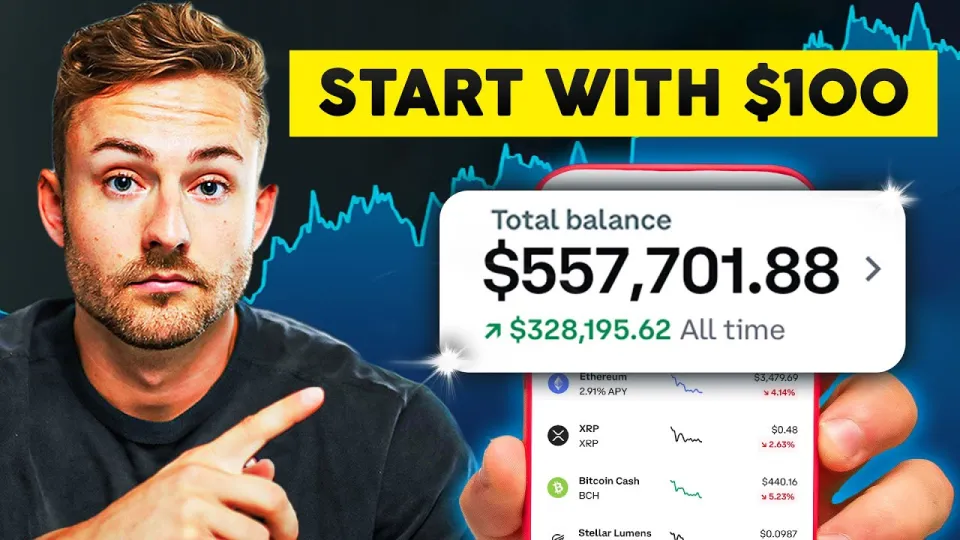
Video: How To Invest in Crypto as A COMPLETE Beginner [2025 GUIDE]
Want articles like this for your own video to promote it on YouTube and Google? Order them through the Telegram bot @sat_sit_bot. It writes articles around your video, embeds the video and publishes them on popular niche websites (no ads). Your first 50 articles are free.
· based on the channel Craig Percoco
Crypto investing for a complete beginner means learning a repeatable process before risking money: understand what a coin actually is, check its fundamentals and tokenomics, read a chart, size every position so a single loss cannot end your account, and buy through a reputable exchange with a written plan. Craig Percoco, who has traded and invested for seven years, structures exactly this path in his beginner guide, and his free training link is the fastest place to start: start learning trading for free.
What crypto actually is before you buy anything
Crypto is a market of digital assets that settle on blockchains, and the first job of a beginner is to separate the asset from the technology and the narrative. Bitcoin is the original scarce digital asset with a fixed supply schedule; Ethereum is a programmable network that hosts applications and tokens; thousands of altcoins sit further down the risk curve. The market is open 24/7, it is far more volatile than equities, and nothing about a green candle guarantees the next one will be green.
A beginner should be able to answer three questions about any coin before buying: what does it do, who pays for it, and who controls the supply. If you cannot answer those, you are not investing, you are guessing. The video's author frames crypto as an emerging market with generational-wealth potential — a genuine opportunity, but one that punishes people who arrive without a method.
The fundamentals that filter out most bad coins
Fundamentals are the part of research that tells you whether an asset deserves capital at all, independent of what the chart is doing today. In crypto the core fundamental is tokenomics: total supply, circulating supply, inflation or emission schedule, unlocks, and how much of the supply the team and early investors hold. A coin with a large unlock scheduled in a few months faces selling pressure that has nothing to do with its technology.
Use a short checklist before any purchase:
- Use case and demand — does the network or token capture fees, users or value in a way that grows?
- Supply schedule — how many tokens exist, how many are released, and when do insider allocations unlock?
- Team and history — who built it, what have they shipped, and have they delivered before?
- Liquidity — is the asset traded on major venues with enough volume to exit your position?
- Narrative timing — is this sector in favour, or are you buying a story that already peaked?
None of these guarantees profit, but together they remove the worst candidates. Most beginner losses come from buying a ticker someone mentioned, not from buying a bad entry on a good asset.
Technicals for people who have never opened a chart
Technical analysis is the study of price and volume to decide when to act, and a beginner needs only a small toolkit: trend, support and resistance, and volume. Open a daily chart, zoom out, and ask whether price is making higher highs and higher lows, lower highs and lower lows, or chopping sideways. Trading with the higher-timeframe trend is the simplest edge available to a new investor.
Support is a price zone where buyers previously stepped in; resistance is where sellers previously appeared. These are zones, not exact lines, and they matter most when they coincide with round numbers or prior highs and lows. Volume confirms whether a move has participation behind it — a breakout on thin volume is the classic false breakout that traps beginners.
The video's author also points to TradingView as his charting tool: TradingView charting. You do not need a paid plan to start; a daily chart and clean levels are enough for your first year.
How to make money without blowing up your account
Profit in crypto comes from position sizing and risk control far more than from picking the perfect coin. Decide in advance the maximum you will lose on a single idea — commonly 1% to 2% of the account — and let that number, not your conviction, determine how much you buy. If your stop is 10% below entry and you risk 1% of a $5,000 account, your position is $500, not $5,000.
Three habits do most of the work:
- Write the plan before the trade — entry, invalidation level, target and size, all recorded.
- Journal every trade — the reason you entered, what happened, and what you would repeat.
- Separate investing from trading — long-term allocations to large, liquid assets belong in a different bucket from short-term trades, and the two should never share the same risk budget.
Leverage and futures amplify both directions and are the fastest route to liquidation for someone still learning the basics. A beginner does not need 10x; a beginner needs to survive long enough to become experienced.
How to buy and sell crypto safely
Buying crypto means opening an account on a regulated exchange, completing identity verification, funding it with a bank transfer or card, and placing an order — market for immediate execution, limit for a specific price. Coinbase and Bybit are the two venues named around the video, and the author links his Bybit partner page: trade on Bybit. Fees differ meaningfully between market and limit orders and between makers and takers, so check the fee schedule before your first purchase.
After buying, move long-term holdings to a hardware wallet or a wallet where you control the seed phrase. Exchange balances are convenient for trading but they are custody held by a company, not by you. Never share a seed phrase, never store it in a screenshot or cloud note, and treat any message offering to "validate" your wallet as a theft attempt.
Selling works the same way in reverse: place a limit order at your target rather than dumping at market, and withdraw profits to a bank account so gains are real rather than theoretical. A written sell plan made at entry removes the emotional decision later.
The questions beginners actually ask
The most common doubts from new investors are not about which coin to buy — they are about discipline. Traders describe years of losses from trading alone without a mentor, then credit a structured process and risk management for turning results around. Others admit they keep taking small, poorly planned trades that cannot change their finances, chasing setups that fail. The honest answer to both is that no coach, signal group or indicator replaces a documented system you execute consistently.
A second recurring theme is skepticism: people want to learn but do not trust the space. That skepticism is healthy. Verify claims, start with an amount you can afford to lose entirely, and test any strategy on paper before funding it. If a promise sounds like guaranteed monthly returns, it is marketing, not investing.
Useful links
- Free trading training: https://bit.ly/3VHSOeT
- Crypto trading course and private team: https://bit.ly/3xhn47c
- Discord community access: https://bit.ly/3VmrO3r
- All resources: https://bit.ly/3zeM13u
- TradingView charting: https://bit.ly/3Xf9uvz
- Bybit trading: https://partner.bybit.com/b/fortraders
Final thoughts
Crypto rewards preparation and punishes improvisation, which is why a beginner's first investment should be in knowledge rather than in a ticker. Master tokenomics, read a daily chart, size positions so no single loss matters, and journal every decision until the process becomes automatic. Craig Percoco's beginner guide is a useful map of that route, and his free trading training is the logical first step before any capital leaves your bank account. Treat every video, including this one, as education rather than financial advice, and never invest money you cannot afford to lose.
Key takeaways
- Crypto is an emerging market with generational-wealth potential, but the majority of retail traders lose money because they trade without a system.
- Craig Percoco built his beginner framework on seven years of trading and splits it into basics, fundamentals, technicals, execution and organization.
- Fundamentals include tokenomics, supply schedule and real use case; technicals cover chart structure, support and resistance, and trend.
- Risk management and journaling matter more than any single trade — position size, stop placement and a written plan decide survival.
- Free structured training from the video's author is available at https://bit.ly/3VHSOeT before you put real capital at risk.
Source: How To Invest in Crypto as A COMPLETE Beginner [2025 GUIDE] · Markdown version
Questions & answers
How much money do I need to start investing in crypto?
You can start with a very small amount because most exchanges allow fractional purchases, but the more useful question is how much you can afford to lose entirely. A common approach is to begin with an amount small enough that a 100% loss would not affect your finances, and to treat the first months as paid education rather than income.
Is it better to invest long term or trade short term as a beginner?
Long-term positions in large, liquid assets are far more forgiving for a beginner because they do not require timing entries or managing leverage. Short-term trading demands a tested system, journaling and strict risk limits, and most new traders lose money before they develop those habits.
Do I need a mentor or paid course to learn crypto?
Not necessarily, but structure matters more than price. Free resources, a written plan and a trade journal cover most of what a beginner needs; a course or community helps mainly by shortening the feedback loop and enforcing accountability. Avoid anyone promising guaranteed returns.
How do I keep my crypto safe after buying it?
Move long-term holdings into a wallet where you control the seed phrase, ideally a hardware wallet, and keep the phrase offline and never shared. Leave only trading capital on exchanges, enable two-factor authentication, and treat unsolicited wallet-validation messages as scams.